
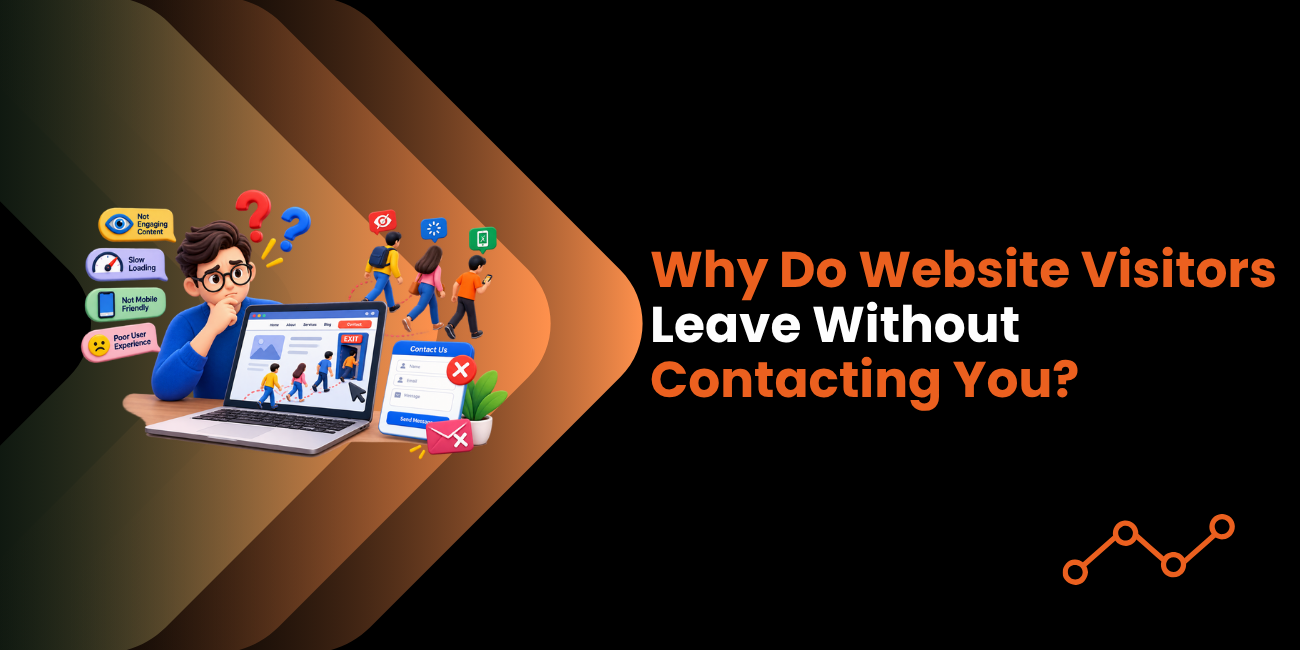
Why Do Website Visitors Leave Without Contacting You?
Your website gets traffic every day. But how many of those visitors actually become enquiries?
If people are visiting your website but your phone isn't ringing and your contact form stays empty, the problem may not be your traffic. You may have a conversion problem.
We've seen this happen with businesses that rank well on Google, run social media campaigns, and invest in advertising, yet still struggle to generate consistent enquiries.
The reason is often simple: visitors are interested, but something makes them hesitate.
Maybe they don't trust the business yet. Maybe they can't find the information they need. Perhaps the website is slow, confusing, difficult to use on mobile, or doesn't make the next step clear.
At SME Digital, we look beyond traffic numbers. We examine what happens after visitors arrive and identify the points where potential customers lose interest.
Here are the most common reasons visitors leave without contacting your business — and what you can do about them.
The Real Problem Isn't Always Traffic
Getting more visitors sounds like the obvious solution when your website isn't generating enough leads.
But imagine a physical shop with hundreds of people walking through the door every day. If most of them look around and leave without speaking to anyone, getting even more people into the shop won't solve the real problem.
The same thing happens online.
Your website needs to do more than attract visitors. It needs to help them understand your business, build confidence, answer their questions, and make contacting you easy.
Before investing more money into advertising or SEO, ask:
- Are visitors finding what they came for?
- Do they understand what your business offers?
- Can they quickly see why they should choose you?
- Is your website building trust?
- Is the next step obvious?
- Is contacting your business easy?
If the answer to several of these questions is no, improving your website may generate more value from the traffic you already have.
1. Visitors Don't Trust Your Business Quickly Enough
Think about what happens when someone discovers your business for the first time.
They don't know you yet. They don't know whether your service is good, whether your team is experienced, or whether previous customers were happy.
Your website has to answer those doubts.
A professional-looking website helps, but design alone isn't enough. Visitors also look for evidence that your business is genuine and experienced.
Useful trust signals include:
- Genuine customer testimonials
- Google reviews
- Client logos
- Certifications
- Awards and recognitions
- Project portfolios
- Case studies
- Team information
- Business address and contact details
- Secure website connection
Don't hide all your trust signals on a separate testimonials page.
If someone is deciding whether to contact you, show relevant reviews, projects, or results close to the point where they're making that decision.
Our Tip
Think about every important service page.
Ask yourself: “If this were the first page a potential customer saw, would they have enough reasons to trust us?”
If not, add the evidence they need.
2. Your Website Doesn't Match What Visitors Are Looking For
Not every visitor arrives with the same intention.
Someone searching for “website development company in Chennai” may be actively looking for a provider.
Someone searching for “how much does website development cost” may still be researching.
Another person may be comparing several companies before making a decision.
Your website needs to address these different stages.
This is where search intent becomes important.
Instead of creating pages simply because a keyword has search volume, create content that answers what your potential customers actually want to know.
For example, service pages can explain:
- What you offer
- Who the service is for
- How the process works
- What makes your approach different
- Common customer questions
- Expected outcomes
- How to get started
When your content matches the visitor's intent, they have fewer reasons to leave and search elsewhere.
3. Your Website Is Too Slow
Nobody likes waiting for a website to load.
A visitor may be interested in your service, but if the page takes too long to become usable, they may simply go back to Google and choose another result.
Common causes of slow websites include:
- Large image files
- Unoptimized JavaScript
- Slow hosting
- Too many plugins
- Poor caching
- Unnecessary animations
- Heavy third-party scripts
Website performance also affects the overall user experience and is an important part of technical SEO.
At SME Digital, we look at performance as part of the bigger conversion journey. A faster website isn't just about improving a technical score. It helps visitors access your content without unnecessary frustration.
Our Tip
Check your most important pages first — especially your homepage, service pages and landing pages.
Don't optimize the website simply to achieve a perfect score. Focus on creating a fast, smooth experience for real users.
4. Visitors Don't Know What to Do Next
A visitor finishes reading your service page.
Now what?
If the answer isn't obvious, you've created unnecessary friction.
Many business websites use vague buttons such as:
- Learn More
- Explore
- Discover
- Read More
These aren't necessarily bad, but they don't always tell the visitor what happens next.
A stronger CTA could be:
- Request a Quote
- Book a Consultation
- Talk to Our Team
- Get a Website Audit
- Ask for a Free Consultation
Your CTA should match the visitor's stage in the buying journey.
Someone reading an educational blog may not be ready to “Buy Now”. But they may be interested in downloading a guide, asking a question, or exploring a related service.
Our Tip
Give important pages one clear primary action.
Don't make visitors work out what you want them to do.
5. Poor UX Makes People Work Too Hard
Your website shouldn't require visitors to figure out how it works.
If someone has to click through five pages just to find your service information or search through a confusing menu to find your contact details, there's a good chance they'll leave.
Common UX problems include:
- Complicated navigation
- Cluttered layouts
- Too much text without proper headings
- Small buttons
- Poor colour contrast
- Difficult-to-read fonts
- Broken links
- Outdated information
- Important services buried several clicks deep
Good UX is about making the customer's journey easier.
Visitors don't care how your company has organized its departments. They care about finding an answer to their problem quickly.
Our Tip
Look at your website from a customer's perspective.
Can someone who has never visited your site find your main service, understand its benefits and contact you without getting confused?
If not, your navigation needs work.
6. Your Contact Form Feels Like Too Much Work
Getting visitors to your contact page is only part of the process.
You also need to make it easy for them to enquire.
A form asking for name, email, phone number, company name, address, budget, requirements and several other details can feel like a lot of work — especially for someone making an initial enquiry.
Sometimes, a simpler approach works better.
For example, an interactive enquiry chatbot can ask one question at a time:
“What service are you looking for?”
The visitor chooses an option and continues to the next question.
Instead of staring at a long form, they feel like they're having a short conversation.
At SME Digital, we recommend exploring interactive lead-collection tools such as Collect.chat when they fit the business and its enquiry process.
Depending on the setup, an interactive chatbot can:
- Ask questions step by step
- Collect visitor details
- Qualify enquiries
- Reduce form friction
- Send lead information to email or CRM systems
- Remain available outside business hours
- Customize questions for different services
The important thing isn't simply adding a chatbot.
The goal is to make the process of becoming a lead easier.
Our Tip
Don't ask for information you don't actually need at the beginning of the conversation.
Start simple. Build the conversation naturally.
7. Your Mobile Experience Is Letting You Down
A website can look fantastic on a desktop and still provide a frustrating experience on a smartphone.
Think about someone searching for your business while they're travelling, waiting somewhere, or simply browsing from their phone.
If your website has:
- Text that is difficult to read
- Buttons that are difficult to tap
- Images that don't fit the screen
- Overlapping elements
- Slow-loading pages
- Difficult navigation
they may leave before ever reaching your contact details.
For businesses investing in Website Development in Chennai, responsive design should be considered from the beginning rather than treated as an afterthought.
Mobile Checklist
| Website Element | What to Check |
| Responsive design | Does the page adapt properly to different screens? |
| Page speed | Does the content load quickly? |
| Buttons | Can users tap them easily? |
| Text | Is it comfortable to read without zooming? |
| Images | Are they properly optimized? |
| CTA | Is the next step easy to find? |
A good mobile experience should feel natural, not like a smaller version of the desktop website.
8. Your Website Isn't Guiding Visitors Towards Conversion
Most visitors aren't ready to contact a business immediately.
They may first discover you through Google.
Then they may read your service page.
Next, they might check your reviews, look at your projects, read a blog, compare competitors and finally decide whether to enquire.
That's a journey.
Your website should support that journey.
Awareness
The visitor discovers your business through search, social media, referrals or advertising.
↓
Consideration
They explore your services and try to understand whether your business can solve their problem.
↓
Trust
They look for reviews, case studies, projects, expertise and answers to their questions.
↓
Conversion
They request a quote, call your business, book a consultation or submit an enquiry.
If your website jumps directly from “Here are our services” to “Contact Us” without building confidence, you may lose visitors along the way.
9. You're Making Website Decisions Without Looking at Data
One of the biggest mistakes businesses make is changing their website based entirely on personal opinions.
Someone says the button should be blue.
Someone else thinks the headline should be bigger.
Another person wants a completely different homepage.
But what does the data say?
At SME Digital, we look at information such as:
- Google Analytics
- Google Search Console
- Heatmaps
- Session recordings
- Scroll behaviour
- Click activity
- Landing-page performance
- Exit pages
- Engagement
- Conversion events
This helps answer much more useful questions.
Where are visitors dropping off?
Which pages generate enquiries?
Which CTA gets ignored?
Which service page attracts traffic but produces no leads?
For example, if a pricing page receives significant traffic but visitors leave quickly, the problem may not necessarily be your pricing. The page may lack context, trust signals, FAQs or a clear next step.
Data gives you a starting point for improvement.
10. Your Content Doesn't Show Why You're Worth Choosing
Visitors don't just want to know what you sell.
They want to know whether you understand their problem.
This is where useful content becomes important.
Instead of filling your website with generic promotional statements, create content that helps potential customers make better decisions.
You could publish:
- Practical guides
- FAQs
- Case studies
- Comparison articles
- Industry insights
- Problem-solving blogs
- Step-by-step guides
- Customer success stories
For businesses investing in SEO Services in Chennai, this type of content can support both search visibility and the customer journey.
Someone may discover your business through a blog today and become a lead weeks later.
Good content doesn't always create an immediate enquiry. Sometimes its job is to build familiarity and trust until the visitor is ready.
11. Your Website Isn't Connected to Your Marketing
Your website shouldn't operate separately from the rest of your marketing.
SEO brings people to the website.
Social media creates interest.
Paid campaigns bring targeted visitors.
Email keeps prospects engaged.
Your website needs to connect these activities and give visitors a clear next step.
When your website and marketing strategy work together, you can better understand where leads are coming from and which campaigns are actually contributing to enquiries.
With the right Digital Marketing Services in Chennai, your website can become more than an online brochure. It can become the central point where traffic turns into measurable business opportunities.
Website Conversion Audit Checklist
Before spending more money trying to attract traffic, take a few minutes to check your website.
| Website Factor | Question to Ask |
| Page Speed | Do important pages load quickly? |
| UX | Can visitors find what they need easily? |
| Mobile | Does the website work properly on phones? |
| Trust | Are reviews, projects or credentials visible? |
| CTA | Is the next step clear? |
| Forms | Is it easy to enquire? |
| Content | Does the website answer customer questions? |
| SEO | Can search engines properly understand the pages? |
| Analytics | Are enquiries and user behaviour being tracked? |
If several answers are “no”, you may have found some of the reasons your website isn't generating enough leads.
What Can You Improve First?
You don't necessarily need a complete website redesign.
Sometimes a few focused improvements can make a noticeable difference.
Start with these:
- Replace generic headlines with customer-focused messaging
- Add testimonials near important conversion points
- Make your main CTA clearer
- Reduce unnecessary contact-form fields
- Improve page speed
- Fix mobile usability problems
- Strengthen important service pages
- Add useful FAQs
- Use internal links to guide visitors
- Review analytics and heatmaps
- Test different CTAs and landing-page layouts
The goal isn't to change everything at once.
Find where visitors are struggling and fix those problems first.
Website Conversion Trends Businesses Should Watch
Website expectations continue to change, and businesses need to adapt to how customers now research and make decisions.
AI-Assisted Customer Support
Visitors increasingly expect quick answers. AI-assisted chat and automated enquiry systems can help answer common questions and collect initial information while still allowing your team to take over when human support is needed.
Service-Specific Landing Pages
Instead of sending every visitor to your homepage, create pages designed around specific services, industries or campaigns.
A visitor searching for a particular solution should land on a page that immediately speaks to that need.
First-Party Lead Data
Your own customer and enquiry data can help you understand what your audience wants and where leads are coming from.
Forms, enquiries, consultations and customer interactions can all provide useful insights when collected and managed responsibly.
Continuous Website Improvement
A website shouldn't be treated as a project that is “finished” forever.
Customer expectations change. Search behaviour changes. Your services change.
Regular testing and improvement can help your website continue to perform as your business grows.
How SME Digital Helps Businesses Convert More Visitors?
At SME Digital, we don't believe every business needs to start from scratch.
Sometimes the website already has good traffic. The problem is what happens after visitors arrive.
Our approach looks at the complete customer journey — from discovery to enquiry.
Depending on the business, this can include:
| Our Approach | Business Benefit |
| Website performance audit | Identifies technical issues affecting user experience |
| UX/UI improvements | Makes the customer journey easier |
| Conversion Rate Optimization | Helps turn more existing traffic into enquiries |
| Technical SEO | Improves crawlability and search visibility |
| Content strategy | Aligns content with customer needs and search intent |
| Conversion tracking | Shows where enquiries are coming from |
| Core Web Vitals optimization | Supports better website performance |
| Ongoing analysis | Helps identify new opportunities for improvement |
We don't want to make changes simply because they look good.
We want to understand why visitors are leaving and what can encourage more of them to take the next step.
Is Your Website Helping or Holding Your Business Back?
Ask yourself:
- Can visitors understand what you offer within a few seconds?
- Does your website build trust?
- Are your service pages answering real customer questions?
- Is your website easy to use on mobile?
- Can visitors contact you without unnecessary effort?
- Are your CTAs clear?
- Are you tracking enquiries and user behaviour?
- Do you know which pages are losing potential customers?
If several answers are “no”, your website may be costing you leads without you realizing it.
More traffic isn't always the answer.
Sometimes, the better opportunity is to make more of the traffic you already have.
Frequently Asked Questions
Why do visitors leave my website without contacting me?
Visitors may leave because the website is slow, confusing, difficult to use, doesn't build enough trust, doesn't answer their questions, or doesn't make the next step clear.
How can I get more leads from my website?
Start by improving your most important pages. Make your messaging clearer, add trust signals, simplify your enquiry process, improve mobile usability, strengthen CTAs and use analytics to identify where visitors are dropping off.
Does website speed affect lead generation?
Yes. A slow website can create frustration and cause visitors to leave before they see your content or contact options. Improving performance can create a smoother experience.
Should I use a chatbot instead of a contact form?
Not necessarily. A chatbot can be useful when visitors need a guided, conversational way to enquire. A short traditional form may work better for some businesses. The right choice depends on your audience and enquiry process.
How often should I audit my website?
A website audit every three to six months is a practical starting point. You should also review performance whenever you launch major changes, notice a drop in enquiries, or change your marketing strategy.
Final Thoughts
Your website doesn't need thousands of visitors to become a valuable business asset.
It needs to do a good job with the visitors you already have.
When someone arrives on your website, they should quickly understand who you are, what you offer, why they should trust you, and what they should do next.
If any part of that journey creates doubt or frustration, the visitor may leave — even if they were genuinely interested in your service.
At SME Digital, we look at more than rankings and traffic. We look at how people actually experience your website and where potential enquiries are being lost.
Whether the problem is unclear messaging, weak CTAs, poor UX, slow pages, complicated forms, missing trust signals or a disconnected marketing strategy, the right improvements can help you get more value from the traffic you're already attracting.
A website shouldn't simply bring people to your business. It should give them a reason to stay, trust you and start a conversation.
If your website is getting visitors but not generating the leads you expect, it may be time to look beyond traffic and start looking at conversion.